EMA EPAR: how to search the EU database of authorised medicines
A European Public Assessment Report (EPAR) is the EMA's public record of a medicine it evaluated — what was authorised in the EU, for which indications, and how the evidence was assessed. Here is how to find EPARs, how to download the whole medicines list, and what the data can and cannot tell you.
The catch: EMA publishes one EPAR page per medicine and a spreadsheet of every centrally authorised product, but neither shows the drug's U.S. approval or the trials still testing it — and catching a withdrawal or a new authorisation means re-downloading the table.
ClinicaLister finds the trials for the drugs, devices and diseases you track — under every drug name and disease subtype, in the U.S. and EU — and shows each one beside its approvals, label and safety data. Every fact names its source, and changes reach you by email. Put each drug's EMA authorisation and designations next to its FDA approval on the same molecule, linked to the ClinicalTrials.gov and CTIS trials studying it, with status changes in your monitoring view.
EMA EPAR in ClinicaLister
What is EMA EPAR?
Medicines that go through the EU's centralised procedure are assessed by EMA's scientific committees — the CHMP for human medicines — and authorised by the European Commission for the whole EU. For each of them EMA publishes an EPAR: a medicine overview in plain language, the product information (summary of product characteristics, package leaflet and labelling) in the EU languages, the public assessment report behind the initial decision, and a running log of the procedural steps taken after authorisation. Refused and withdrawn applications are published too.
Each EPAR page carries the structured facts regulatory and market-access teams look up most: the EMA product number (EMEA/H/C/…), active substance and INN, therapeutic area, ATC code, marketing authorisation holder, opinion and authorisation dates, and the revision number. The same facts, for every medicine at once, are in EMA's downloadable Medicines data table, along with flags for orphan status, conditional approval, exceptional circumstances, PRIME, biosimilars, generics and advanced therapies.
The scope matters. EMA's site holds only medicines EMA evaluated. A drug authorised country by country through the national, mutual-recognition or decentralised procedures — many generics and older medicines — may not appear at all; for those, EMA points to the national medicines registers.
- Published by
- European Medicines Agency (EMA)
- Updated
- Data tables refreshed overnight; each EPAR revised as the authorisation changes
- Official site
- EMA medicines search
How to search EMA EPAR
Use the medicines search to read one EPAR, and the downloadable data table when you need a list, a count or a comparison across medicines.
- 1
Search by name or active substance
On EMA's Medicines page, type a brand name or active substance and set the medicine type to human, veterinary or herbal. Advanced search adds filters and also returns refused and withdrawn medicines, which the simple search can hide.
- 2
Read the EPAR page from the top
The overview summarises what the medicine is for and why it was authorised. Product details and Authorisation details give the product number, holder, therapeutic area, ATC code, dates and current revision. Product information holds the SmPC and leaflet.
- 3
Open the assessment history for the evidence
"EPAR - Public assessment report" is the CHMP's assessment at initial authorisation, including the clinical data it relied on. "Procedural steps taken and scientific information after authorisation" lists every later variation, extension of indication and safety review.
- 4
Download the Medicines data table for the whole list
On Download medicine data, the Medicines table is one Excel file covering authorised medicines, withdrawn applications and opinions, refreshed overnight. Filter on Category (Human or Veterinary) and Medicine status (for example Authorised) to get the current EU-authorised list, and use the designation columns to pick out orphans, biosimilars or conditional approvals.
- 5
Add the companion tables you need
The same page has separate tables for post-authorisation procedures, referrals, orphan designations, paediatric investigation plans, PSUSA outcomes, safety communications (DHPCs) and shortages. EMA also publishes the same data as JSON for automated use.
Limits of the official search
- Only centrally authorised medicines are covered; nationally authorised products need each country's register, so EMA's list is not every medicine on the EU market.
- One medicine is one EPAR page. There is no view of every EU authorisation for a substance across holders next to its U.S. approval.
- The scientific content sits in PDFs — assessment reports, SmPCs, procedural-steps logs — that the data table only links to, so comparing indications or evidence across medicines is manual.
- An EPAR does not list the medicine's ongoing clinical trials; finding them means a separate search in CTIS or ClinicalTrials.gov.
- There are no alerts: catching a status change, a new indication or a withdrawal means re-downloading the table or watching each page.
EMA EPAR on its own stops here
See a drug's EU and U.S. authorisations next to its trials
Founding pricing for early-access members
What ClinicaLister adds to EMA EPAR
EU authorisation beside the FDA approval
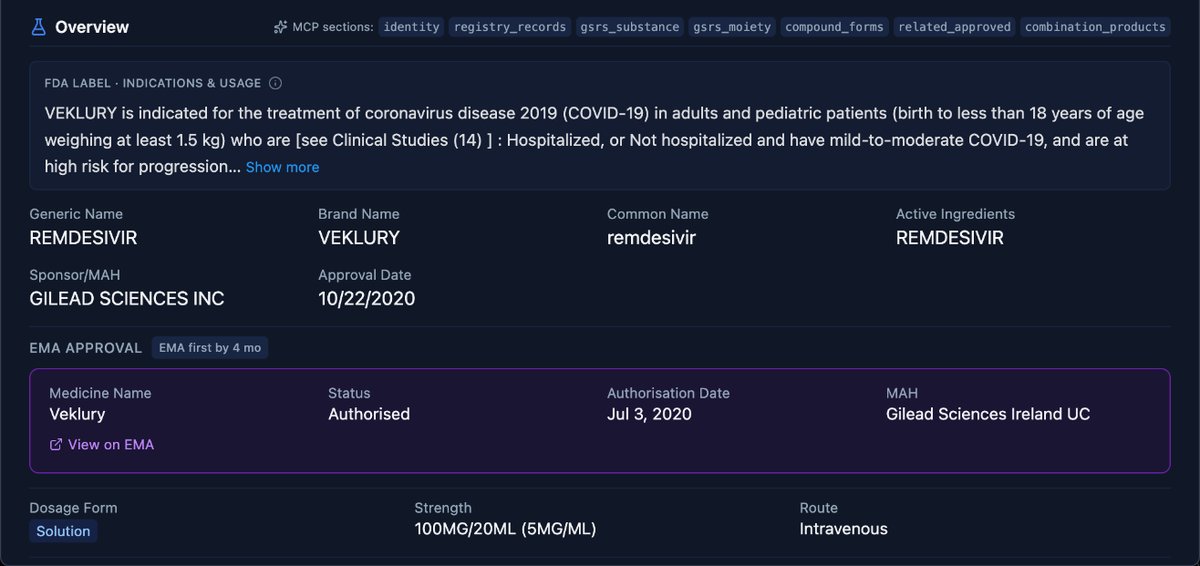
A drug's detail view shows its EMA record next to its Drugs@FDA record, with a link to each regulator's page and the EMA designations — orphan, conditional approval, exceptional circumstances — alongside the FDA ones.
Anchored to the substance
93% of the human-medicine records ClinicaLister holds carry a UNII substance code, so an EU brand meets its U.S. counterparts, labels and NDC products on the same molecule instead of by name matching.
Linked to the trials studying the drug
Through its molecule, an EU-authorised medicine connects to the ClinicalTrials.gov trials testing it, and EMA records are also linked to EU CTIS trials, so an authorisation sits next to the development still underway.
Charts across the drugs in your trials
Dashboard charts show the EMA therapeutic areas and designations of the drugs linked to the trials you follow, and the approval lag between FDA and EMA for molecules approved in both — split by which agency approved first.
Status changes in your Monitoring view
Changes to an EMA record's authorisation status, date, active substance or procedure for drugs linked to your trials appear in the app's Monitoring view, so a withdrawal or new authorisation is not missed.
EMA EPAR coverage
2,750+
EMA medicine records — the full Medicines table
1,560+
human medicines currently authorised
93%
of human medicines anchored to a UNII
95%
of human medicines linked to at least one trial
ClinicaLister holds EMA's full Medicines data table — about 2,350 human and 400 veterinary records, including refused and withdrawn medicines — synced daily. It holds the table's structured fields and links to each EPAR page; the EPAR documents themselves (assessment reports, SmPC text) are not loaded. Counts measured on the ClinicaLister platform database, November 2026.
EMA EPAR: frequently asked questions
What is an EPAR?
A European Public Assessment Report is the set of documents EMA publishes for a medicine it evaluated through the centralised procedure: a plain-language overview, the product information, the public assessment report and the history of changes since authorisation.
Does every medicine sold in the EU have an EPAR?
No. Only medicines evaluated by EMA through the centralised procedure have one. Medicines authorised by individual countries through national, mutual-recognition or decentralised procedures are listed in the national registers instead.
How do I get a list of all EMA-approved drugs?
Download the Medicines data table from EMA's Download medicine data page, then filter Category to Human and Medicine status to Authorised. The table is refreshed overnight and includes withdrawn, refused and lapsed medicines, so the status filter matters.
Who grants an EU marketing authorisation, EMA or the European Commission?
EMA's committee adopts a scientific opinion; the European Commission then issues the legally binding marketing authorisation. An EPAR shows both dates — opinion adopted and marketing authorisation issued.
How often are EPARs updated?
Each EPAR is revised when the authorisation changes, such as a new indication or a safety update, and its revision number increases. The downloadable data tables are refreshed overnight.
Is the EMA EPAR database the same as EU CTIS?
No. EPARs cover medicines that have been assessed for authorisation. CTIS is the EU's clinical trials system, holding trials that are planned, running or finished.
Related data sources
See a drug's EU and U.S. authorisations next to its trials
Built for biotech competitive-intelligence teams, and used by the Regulatory Affairs Specialist. See it in the product: Drug & Device Details. All data sources
See a drug's EU and U.S. authorisations next to its trials
One drug's approvals, label, safety, patents and US pricing in one panel, every section sourced. Tell us what you track and we'll set it up for you. Founding pricing for early-access members.